|
THE
BOW-WOW SHOP |
Michael Glover |
|
THE
BOW-WOW SHOP |
Michael Glover |
Refracting Rilke
Good afternoon to all readers of The Bow-Wow Shop, past, present and to come. We were born in 2009, and died, rather abruptly, in a fit of some perplexity, in 2016. And now the world of civilised discourse has made it plain to us, through various twisty back channels, that it needs us again in all the sobriety of our rascality. We live in dangerous times, and it was for this very reason that, early this morning, I threw back my door here in Clapham to let in a deafening Dawn Chorus of Saucy Putinescas and light-of-foot Trumpettina Castrati, all in their silver shoon. Were they indeed a threat to us? Or could they be smudged out with a rubber? And who would help?
No one better, came back a murmuration of light-winging starlings who happened just then to be breasting the roof-line, than Rainer Maria Rilke, that Austrian poet who died of leukaemia in 1923, author of the Duino Elegies and Sonnets to Orpheus, a man so winningly feather-light of touch, a poet so mystically self-absorbed, that he could not fail to win over the worst brute in the world. What harm could there possibly be in Rilke?
And so, over the coming days and weeks, we will be presenting a selection of responses to - or perhaps they are refractions of - the man, his work, and what the very idea of him has represented to poets. What have they made of his angels, his addiction to soulfulness, his soft-power allure, his way with fine-boned aristocratic women?
On Not Translating Rilke
To go in pursuit of the late poetry of Rilke is to seek out a ghost, a body disembodied. His presence feels immaterial, forever ungraspable, intangible, ethereal. It is as if he only tentatively presumes to exist in this world of cups and saucers and bombs and butter. Photographs of him seem only to prove as much. He looks absent, elusive, awkwardly solemn, dully respectable almost to the point of nullity, unwilling to be characterised or defined, let alone befriended. To endeavour to bring some sense of him over in a language not his own (his was German, as I am sure you know) would be laughable, an act of the utmost futility. What then is to be done by way of a response to the man and his words if anything that amounts to translation seems out of the question?
Would it be possible, I wondered, and this in spite of a belief on my part that to do so would yield nothing of value, somehow to set up a situation (wholly fantastical, of course) in which I walked alongside him for a while, keeping pace with him as he stared ahead or looked down or sniffed the air, having casually drifted into his presence this morning from, well, nowhere in particular, and without even so much as a by-your-leave or an Excuse Me, Herr Rilke? What would be the excuse or the pretext though if, by any chance, he were to turn and raise an eyebrow at my presumption, and even open his mouth? What would I say?
Well, I think I would say that it had something to do with my telling him about the impossibility – my impossibility, that is – of ever really getting to grips with the Duino Elegies, in spite of umpteen attempts to do so, and then going on to explain that all I now felt able to do was to put to him a whole series of comments and questions and queries, not in order to cajole him into saying anything, not in any expectation at all that he would do such a thing, but for my own sake, so that I could contemplate them there, hanging in the upper air, like so many stars in the firmament, a kind of witnessing to the fact that I had at least said something…
So that is what I have done. I have tried my best to seize something of the spirit of the elegies, of the spirit of Rilke writing those elegies, by pretending, in part at least, to re-create them in my own words, yes, not in his words, but in mine. But I have also weaved into this side-on response to his late poetry, the nature of the ghostly presence of the man himself as I perceive him to have been, and of how he responded to his female admirers in his voluminous correspondence, all that quasi-mystical self-absorption…
- Michael Glover
After the Second Elegy
Who can ever be said
to have dissected
the body of an angel?
Who would have the gall,
the chutzpah,
the fervour of violence?
Who would step forward to wield
those gleaming instruments of torture?And in that dramatic act of unmaking,
would there register pain
on the heaven-sent countenance?
Would he remonstrate from the gurney?
Would he invite us to hold back
by recommending a modicum of caution?Or would he lay a gentle,
near weightlessly smooth hand
flat down on our latex-gloved hand?
Would God himself intervene by booming
in magisterial tones from the chilled room
just beyond, inviting us to desist until we had reached
a more perfect level of understanding?Or would our encounter
be just a matter of witnessing
by looking on – as in the case of
that burly young man
who led a small boy called Tobias,
he who swung his giant fish
beside the waters,
understanding so little
of his gentle, patient guardian,
who never really let on?
How much of us can ever remain?
We are the smoke that rises steaming from the pot.
Smell that savour!
Taste of us before we vanish.
Add our meatiness to your meatiness.
We were only ever cannibals.
Our habits were always –
And will forever be – disgusting.The world sets us a-dizzying.
(Who falls, if not a shadow?)
It is a cloud of gnats,
the fall of a girder on a tender foot,
the wheeling of birds in their exquisite formations.
Who faints in its shadow?
Who raises a hand to hold off
that terrible clatter of light-fall?Was I ever this helpless?
Am I to be raised up, by the neck, the hair, the heels?
Pity me, sullied god of love or vengeance.
Pity me for my grossness.
Pity me for being such a willing and helpless prisoner
of my inflated expectations.Where does a smile disappear to
when it so quickly goes?
Is it a butterfly,
to be crushed beneath a heel?
Is it a tune forever fading as you
hurry away from her window?
Is this as far as you are ever capable of seeing?No sooner do we arrive than we leave again,
leaving our flesh behind for meagre contemplation.
If I were pregnant,
I would have a look which could not be shared.
Do not dare then to approach me.
Unlike these houses, these trees, these streets,
we shift and shift again.
We are so much air to be readily displaced.
Are our spirits never to be moored?
Are our bodies never to be nailed to the floor?But with whose hammer?
I stare down and into my two cupped hands.
To be alive is a presumption.
Should I first have asked the question?There are lovers alive in this world
who have always dared,
who have never needed permission.
Such has been the belief of our enduring admiration.
And yet how is such life-long cleaving achieved?
Were you a secular miracle after all?
Could I have prised you apart?
The questions besiege.Is there no space for us?
Is all this headlong outgoing
all that we are capable of?
Or are we, set apart in a world set apart,
to be nothing but the very models of restraint,
aping the best that antiquity had to offer,
tiptoeing like some prettily mincing god
across a stela of the ages?
- Michael Glover
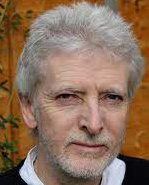
| Michael Glover is a London-based, Sheffield-born, Cambridge-educated poet, novelist, art critic, editor and publisher who has contributed regularly to the Financial Times, The Economist, The Times, the New Statesman and the Tablet. Some of his recent books include Great Works: Encounters with Art (2016), Hypothetical May Morning (2017), John Ruskin: a Dictionary (2019), The Trapper (2021), Nellie’s Devils (2022), The Skittery Zipper (2023) and Vincent’s Poets (2024). |